Don't Let a Small Crack Become a Structural Bill
Parging is your foundation's first line of defence against Edmonton's 50+ annual freeze-thaw cycles. When it begins to fail — cracking, spalling, peeling, or going hollow — every winter that passes without repair deepens the damage and increases the cost to fix it. We repair Edmonton foundations properly: full surface assessment, all loose material removed, professional bonding agent, the right mix for Alberta's temperature range. No shortcuts.
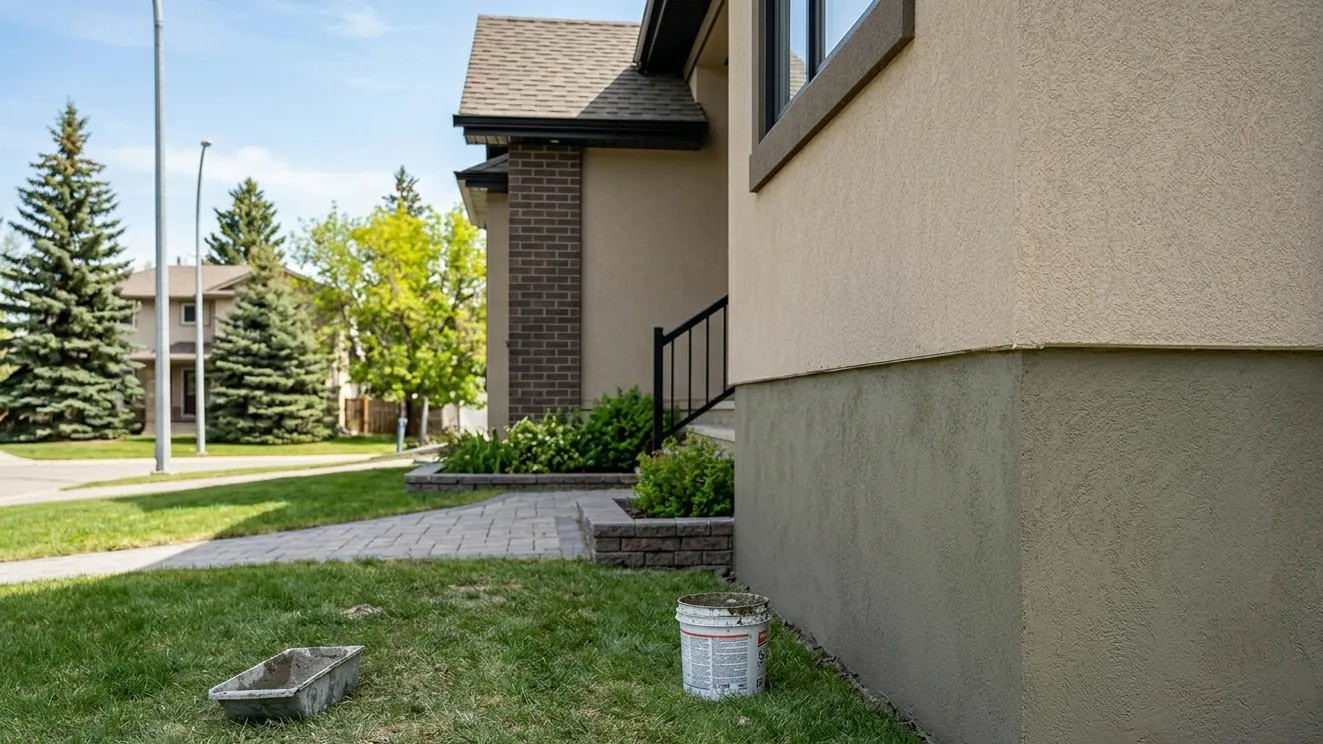
All loose material removed. Surface ground to clean concrete before any new material goes on.
Formulated for Edmonton's -40°C to +30°C range. The step most DIY attempts skip — and why they fail.
Send photos of each wall. Get a clear, itemised estimate before any site visit is needed.
Types of Parging Damage We Repair
Not all parging failures look the same — and the right repair approach depends on what is actually happening to the wall. Here is how we read each damage type and what we do about it:
Cracks — hairline, map, or widening
Repair before next winterFine surface cracks that appeared after a temperature swing are early warning signs — the parging is stressed but still doing its job. We fill and seal these before they allow moisture entry that the next freeze-thaw cycle widens further. Cracks wider than 3mm or cracks accompanied by hollow sections behind them get more extensive treatment: the delaminated area is removed before the crack itself is addressed.
Spalling — chips and flakes falling off the surface
Address this seasonSpalling means freeze-thaw damage is already removing structural concrete. We grind the affected area back to sound material, fill any deep voids with a repair mortar, apply bonding agent, and resurface. Left unaddressed, spalled areas grow with each winter — the exposed pitted surface holds more water than smooth concrete, accelerating the next round of ice expansion.
Hollow spots — parging that sounds dead when tapped
Address before next freezeA dull thud on the tap test means the parging has delaminated from the concrete beneath it — often before it has visibly peeled or cracked. Water is already pooling in the gap. We map all hollow sections across the full perimeter, remove the delaminated material, and prepare the substrate before applying a fresh bonded coat. If hollow sections cover more than 25% of the wall, we will recommend full replacement rather than patching — a fragmented repair on a globally failing surface is not a long-term solution.
Peeling or bubbling parging
Address immediatelyActively peeling parging has lost its bond entirely. The gap between coating and wall is filling with water every rain event and freezing against both surfaces each winter — the most damaging configuration for the concrete beneath it. All delaminated material must be stripped before any new application. We never apply over peeling parging, regardless of what the homeowner requests.
Efflorescence and moisture staining
Assess this seasonWhite powdery deposits or dark patches that don't dry after rain indicate active moisture movement through the wall. We assess whether the parging has cracked enough to allow water entry, or whether a drainage or grading issue is contributing. If the latter, we flag it before recoating — otherwise the new parging works against ongoing hydrostatic pressure and will fail prematurely.
Our 5-Step Repair Process
Understanding what is involved helps you evaluate any quote you receive. A lower quote that skips steps 2–4 is not a bargain — it is a repair that will fail before the next Edmonton winter ends.
Full perimeter assessment
We tap every section of the foundation perimeter — not just the areas you have identified. Hollow sections, crack widths, spalling depth, moisture staining, and grade drainage are all mapped before we quote the repair scope. This takes 20–30 minutes and is the reason our quotes are accurate.
Remove all loose and failed material
Every delaminated section, soft spot, and loose aggregate is cut back or ground away to clean, sound concrete. This is the most time-consuming part of a repair and the step most commonly omitted in low-cost quotes. New material cannot bond to a compromised substrate — skipping this step guarantees failure.
Clean and prepare the substrate
Exposed concrete is wire-brushed and cleaned to remove dust, efflorescence deposits, and surface contamination. The surface must be structurally sound and free of loose material — any residue left behind creates a weak layer between the new coating and the wall.
Apply professional bonding agent
A bonding agent formulated for Edmonton's -40°C to +30°C range is applied to the prepared surface and allowed to reach the correct tack. This step is what separates a repair that lasts a decade from one that pops off in a single winter. It creates a chemical key between the new parging and the existing concrete that freeze-thaw stress cannot break.
Apply parging and monitor cure
The parging mix is applied in one or two coats, worked to match the surrounding texture as closely as possible. We monitor curing conditions after application — no work is placed when temperatures are expected to drop below 5°C within 72 hours, and we reschedule rather than compromise the cure by working in marginal weather.
Why DIY Parging Repairs Fail in Edmonton
We inspect foundations that have been repaired by homeowners every season. The failure pattern is almost always the same, regardless of how carefully the work appeared to have been done:
- No bonding agent. Most hardware store repair guides omit this step. Without it, there is no chemical adhesion — only mechanical contact that freeze-thaw expansion separates within one winter.
- Material applied over loose substrate. Brushing off dust is not the same as grinding back to clean, sound concrete. Any soft or compromised material left in place creates a failure plane directly beneath the new patch.
- Wrong mix for Alberta temperatures. Generic bag cement mixes are not engineered for a 70°C annual temperature swing. The cement matrix contracts and expands differently than professional formulations, cracking from thermal stress alone within a few seasons.
- Applied in marginal weather. Overnight temperatures below 5°C during the cure window prevent proper hydration of the cement. The result looks fine in the short term and fails at the bond layer the following spring.
The Portland Cement Association's research on freeze-thaw resistance is clear that surface repairs on concrete must use the correct bonding systems and substrate preparation to maintain adhesion through repeated freeze-thaw cycles. Without both, the bond fails at the repair interface — not the surrounding material.
Should You Repair or Replace Your Parging?
This is the question we get asked most often, and the answer comes down to one thing: how much of the wall is delaminated. Tap the full perimeter with a hammer. If the hollow thud covers more than 25% of the surface, full replacement is almost always the more cost-effective call over a 10-year horizon — repeated patches on a globally failing system cost more in cumulative labour and material than doing it properly once.
Below 25% delamination with isolated visible damage, targeted repair is the right path — provided the surrounding material is genuinely sound. Our repair vs. replacement guide walks through the full decision, including the cost comparison over 10 years.
Red flag to watch for when getting quotes: Any contractor who offers to apply new parging over existing peeling or hollow sections without removing the failed material first is offering a repair that will not last. The Better Business Bureau's Edmonton chapter recommends getting written quotes from at least three contractors and ensuring each quote specifies the preparation steps included — not just the materials and final application.
"I called three companies. Two gave me a number over the phone without coming out. AxisLayer came out, tapped the whole wall, and showed me exactly which sections were hollow — including areas I hadn't seen. Quote was detailed, work was clean, and it held through two full winters without a single issue."
— Homeowner in Edmonton (Glenora), 2023 project"The repair on our north wall failed twice with another company before we called AxisLayer. They explained why the previous patches kept popping off — no bonding agent, applied over soft concrete. They redid the whole north face properly. That was 2022. Still holding."
— Homeowner in Spruce Grove, 2022 projectWhat Does Parging Repair Cost in Edmonton?
Cost depends entirely on the scope of damage identified during the assessment. We do not quote by the crack — we quote by the full scope of work required:
- Minor patching — isolated cracks, small chips: $500–$1,500
- Sectional repair — one or two problem walls: $1,500–$4,000
- Full-perimeter repair or resurfacing: $4,500–$10,000+
Our 2026 Edmonton parging cost guide breaks these down by per linear foot, per square foot, and by home type so you can estimate your project before reaching out.
Parging Repair Service Area
We provide foundation parging repair across Edmonton and the surrounding region. Most jobs are completed in a single day. Current service area:
Not sure if we cover your area? Send us a message — we take on jobs outside the core service area depending on scope and scheduling.
Not Sure If You Have a Repair Problem?
If you can see visible cracking, chipping, or staining but are not sure whether it is urgent, our parging decision guide walks through exactly how to read what you are seeing — including a 5-step self-inspection you can do yourself in 15 minutes. For moisture staining specifically, our moisture damage guide explains what each type of staining indicates and when it becomes urgent.
Frequently Asked Questions
No. Parging requires temperatures above 5°C during application and for the 72-hour cure window that follows. Edmonton winters routinely drop well below that overnight. Any contractor offering winter parging is offering work that will fail by spring. Our repair season is May through early October.
A repair done with proper surface preparation and bonding agent on sound surrounding concrete lasts 10–15 years. The qualifier is sound surrounding material — if the rest of the parging has widespread delamination, patches will continue failing as the surrounding material deteriorates. In that case, full replacement is the more durable and ultimately cheaper path.
We match texture as closely as possible. Colour is harder — new parging cures lighter than aged material and the difference is visible for one to two seasons until weathering brings it together. For street-facing walls or pre-sale work, full resurfacing of the wall section achieves a uniform result that a patch cannot.
Tap the full perimeter with a hammer. A hollow thud means delamination. If hollow sections cover more than 25% of the total wall area, replacement is almost always more cost-effective over 10 years. Below that, repair is the right call. Our repair vs. replacement guide walks through the full decision.
Minor patching runs $500–$1,500. Sectional repairs covering one or two walls run $1,500–$4,000. Full-perimeter resurfacing starts at $4,500. See our cost guide for a full breakdown.
Recurring failure in the same location almost always means the repair was not addressing the root cause — usually because it was applied without a bonding agent over a compromised substrate. Edmonton's freeze-thaw cycles find every weak bond boundary. If it keeps failing, the surrounding material likely needs full assessment — not another patch in the same spot.
Last reviewed: April 2026 by the AxisLayer Exteriors team, Edmonton, Alberta.
Get a Parging Repair Quote — Send Us Photos
A photo of each wall is all we need to give you an accurate, itemised estimate. Most quotes are turned around within one business day.
Request My Free Quote