Your Foundation Is Telling You Something — Do You Know How to Read It?
Concrete looks solid, but it is naturally porous — and in Edmonton's climate, every rainstorm and snowmelt is an opportunity for moisture to work its way in. The signs appear on the exterior long before you ever notice a damp smell or water stain inside. Learning to read those signs early is the difference between a parging job and a foundation remediation bill.
Why Edmonton Foundations Are Especially Vulnerable
Most Canadian cities deal with winter moisture. Edmonton deals with it on repeat. The city averages over 50 freeze-thaw transitions in a single year — significantly more than milder coastal or central Canadian cities. Each transition is a stress cycle: moisture absorbs into the concrete on a warm day, then freezes and expands by roughly 9% when temperatures drop. That expansion happens inside the pores of the concrete wall itself, generating pressure that progressively fractures the surface from within.
The result is that an Edmonton foundation showing minor efflorescence in spring of year one can have visible parging cracks by year two and active surface delamination by year four — if moisture is not controlled. Understanding what you are seeing on the exterior is the first step in stopping that progression.
Moisture damage is cumulative. Each winter without protection does more damage than the last. The cost of addressing early-stage efflorescence is a fraction of what it costs to remediate spalling and peeling that has been allowed to develop over several seasons.
How to Read the 4 Warning Signs on Your Foundation
Each of these signs tells you something different about what is happening inside your concrete. Not all of them require the same urgency.
Efflorescence — white powdery deposits
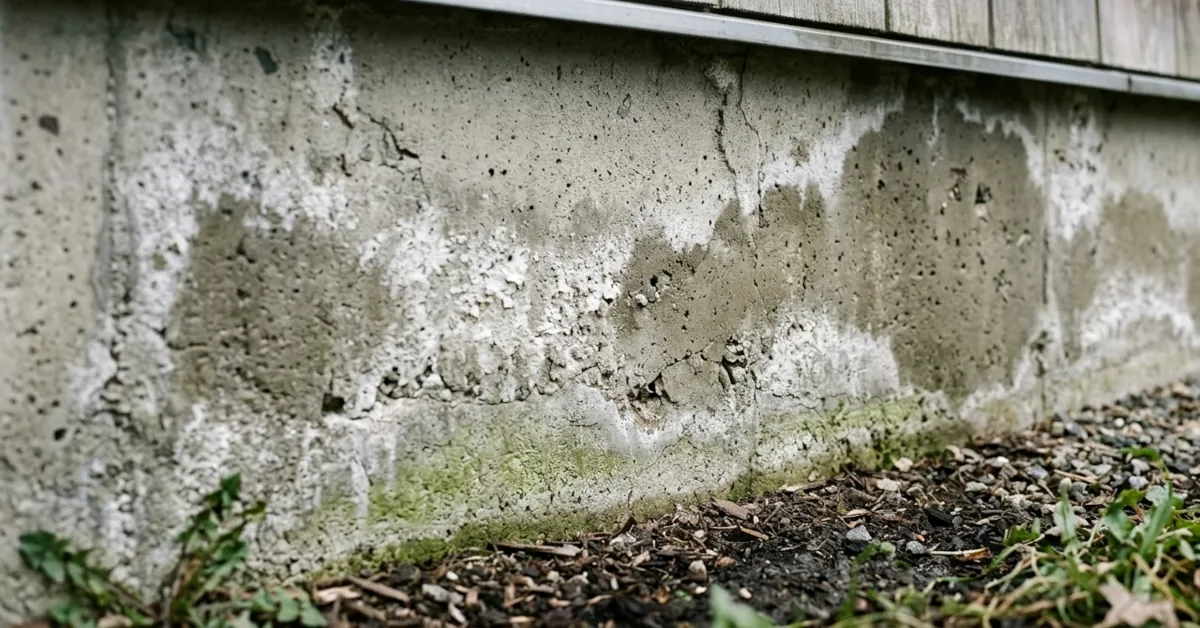
Monitor / Act soonEfflorescence is the white, chalky crust you see on concrete and masonry. It forms when water moves through the concrete, picks up dissolved salts, and deposits them on the surface as the water evaporates. The efflorescence itself is not the problem — it is the symptom. It tells you water is actively moving through the wall.
Light efflorescence that appears once after a wet season and doesn't return is usually low concern. Heavy deposits that come back quickly after cleaning, or deposits that grow and thicken, indicate ongoing water movement that will accelerate concrete deterioration through each freeze-thaw cycle.
Persistent damp spots — patches that won't dry
Act within the seasonAreas of foundation wall that remain visibly darker and wet-looking 24+ hours after rain has stopped are actively absorbing and holding water. This is a more advanced sign than efflorescence alone — it indicates the concrete's pore structure in that area is already saturated and the surface has lost its ability to drain effectively.
These areas are the first to spall in the winter. As the held moisture freezes, the concentrated expansion pressure is much higher than in drier sections of wall, meaning these spots deteriorate faster and deeper with each cold snap.
Spalling — flaking, chipping, or pitting concrete
Address promptlySpalling is what happens after moisture has been doing its work for a while. You will see it as thin concrete "coins" or flakes falling away from the surface, a rough pitted texture like sandpaper or pot-holes, or crumbling edges particularly at the base of the wall near the grade line.
This is no longer a surface coating problem — the structural concrete itself is being physically destroyed. Left alone, spalling deepens each winter and can eventually reach the reinforcing steel inside the wall, which then corrodes and accelerates further fracturing.
Mold or algae staining — green or black growth
Act within the seasonGreen or black biological growth on the exterior foundation — particularly near the grade line, under downspout discharge points, or on north-facing walls that see less direct sun — indicates the surface stays wet long enough and consistently enough to support organic growth. This is a reliable indicator of poor drainage combined with water-absorbing concrete.
Beyond the appearance problem, biological growth on concrete accelerates chemical degradation of the cement matrix. Algae roots penetrate surface pores, and the organic acids they produce slowly break down the bond between aggregate and cement.
Foundation Moisture Prevention: 7 Things Edmonton Homeowners Can Do
Parging is the most effective single intervention, but it works best as part of a broader approach to keeping water away from your foundation wall in the first place.
- Ensure all downspouts discharge at least 2 metres away from the foundation wall — the single most impactful drainage fix most homeowners can make themselves.
- Check that the ground grades away from the house at a minimum 5% slope for the first 1.5 metres. Soil that has settled flat or slopes toward the foundation directs every rainstorm straight at your concrete.
- Keep garden beds immediately adjacent to the foundation shallow and well-draining. Deep mulch against the foundation wall holds moisture against the concrete for extended periods.
- Clear debris from window wells regularly — a blocked window well fills with water and saturates the foundation wall at the most vulnerable point.
- Inspect parging annually in spring for new cracks, chips, or hollow-sounding sections (tap with a hammer — a dull thud indicates delamination). Catching a small repair early costs a fraction of a full redo.
- Have any new parging cracks filled before winter. Even hairline cracks allow moisture entry that the freeze-thaw cycle then widens.
- If your parging is over 10 years old and showing multiple signs of wear, a full replacement before serious moisture damage sets in is usually more cost-effective than waiting. Our repair vs. replacement guide walks through that decision.
How Parging Acts as a Moisture Barrier
Professional foundation parging in Edmonton works as a sacrificial exterior layer that takes the weather instead of your structural concrete. It is not a waterproof membrane — it is a breathable, cementitious coating designed to allow vapour to escape outward while blocking liquid water from entering the wall.
The key properties that make parging effective as a moisture control measure in Edmonton's climate are its density (far fewer and smaller pores than raw concrete), its flexibility when acrylic-modified systems are used (which allows it to absorb freeze-thaw movement without cracking), and its bond strength when properly applied — a well-bonded parging coat doesn't allow moisture to pool at the interface between coating and concrete.
If moisture damage has already progressed to active spalling or peeling parging, the repair approach changes — the failed material must be removed, the concrete surface remediated, and a fresh bonded system applied. Applying new parging over damaged or delaminating old material never works long-term.
"I noticed the white staining on our north wall in the spring and figured it was just cosmetic. By fall we had chunks coming off. AxisLayer removed the damaged section, treated the concrete, and reparaged the whole north face. Two winters later, no staining, no chips. Should have called them the first time I saw it."
— Homeowner in St. Albert, 2024 projectWhat Does Moisture Protection Cost for an Edmonton Foundation?
The earlier you act, the lower the cost. A new parging application on a foundation with only surface efflorescence and no spalling is the most straightforward job. Once spalling has set in and surface remediation is required, costs increase meaningfully.
- Early stage — efflorescence and minor damp spots only: $4,000–$7,000 for full perimeter parging
- Mid stage — localized spalling requiring patch work: $1,500–$4,000 for affected sections
- Advanced stage — widespread delamination and spalling: $7,000–$12,000+ for full removal and reapplication
Our 2026 Edmonton parging cost guide provides a full breakdown by project type so you can estimate where your foundation sits before requesting a quote.
Frequently Asked Questions
The earliest signs are white powdery efflorescence and dark damp patches that don't dry within 24 hours of rain stopping. These indicate water is actively moving through your concrete. Spalling — where the surface chips or flakes — and algae staining near the grade line are later-stage signs that follow if moisture is not controlled.
Occasional light efflorescence can be cosmetic. Heavy deposits that return quickly after cleaning indicate active water movement through the wall. In Edmonton's freeze-thaw climate, ongoing moisture intrusion will progressively worsen spalling and cracking without intervention.
Parging acts as a breathable sacrificial barrier on the exterior face — it slows water absorption significantly and protects the structural concrete from direct weather impact. It is not a substitute for below-grade waterproofing or drainage solutions if you have active basement leaks.
Edmonton averages over 50 freeze-thaw transitions per year. Each one causes absorbed moisture to expand inside concrete pores by roughly 9%, fracturing the surface from within. This cycle compounds every winter — making early protection significantly more cost-effective than deferred repairs.
Light efflorescence can be cleaned with a stiff brush and diluted acid wash. Addressing the cause — failed or absent parging — requires professional surface preparation and reapplication. DIY patches without proper bonding agents fail quickly in Edmonton's climate and can trap moisture, worsening the problem.
Early-stage full-perimeter parging runs $4,000–$7,000. Advanced spalling with surface remediation required can reach $12,000 or more. Acting at the first signs of moisture is consistently the most cost-effective path. See our parging cost guide for a full breakdown.
Last reviewed: April 2026 by the AxisLayer Exteriors team, Edmonton, Alberta.
Protect Your Foundation Before the Next Freeze
Moisture damage compounds every winter. If you are seeing efflorescence, damp patches, or early spalling, now is the time to act. Send us a photo and get an honest assessment of where your foundation stands.
Request a Quote