The Wrong Choice Costs You Twice
Patching parging that should have been replaced leads to repeated failures every one to two winters. Replacing parging that only needed a targeted repair wastes money. Edmonton's freeze-thaw climate makes this decision consequential — here is how to get it right the first time.
Why This Decision Matters More in Edmonton Than Most Cities
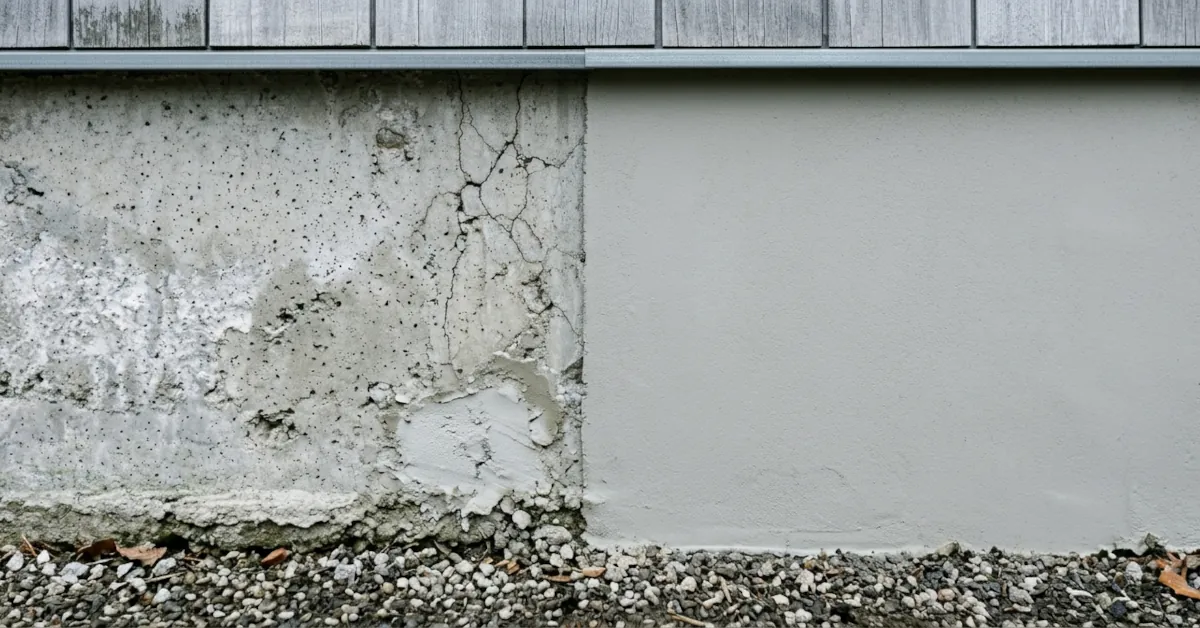
In a mild climate, a parging patch that isn't perfectly bonded might look rough but hold for years. In Edmonton, it won't. The Environment and Climate Change Canada climate normals for Edmonton record over 50 freeze-thaw transitions per year. Each one creates stress at every bond boundary in the coating system. A patch that isn't chemically keyed to the substrate — or that was applied over a surface still carrying delaminated old material — fails at that boundary, usually within one winter.
The Portland Cement Association's guidance on freeze-thaw resistance is clear: surface coatings on concrete only perform as intended when the underlying substrate is sound and the coating is fully bonded. Applying new cementitious material over a partially delaminated surface transfers the bond failure — it doesn't resolve it.
Tap your entire foundation perimeter with a hammer or coin. A hollow thud means that section has delaminated from the concrete beneath it. If hollow sections cover 25% or more of the total wall area, full replacement is almost always more cost-effective than patching. Below 25%, targeted repair is likely the right call — provided the cracks themselves are not widening and the surrounding material is sound.
Side-by-Side: Repair vs. Full Replacement
| Targeted Repair (Patch) | Full Replacement (Redo) | |
|---|---|---|
| Upfront cost | Lower — $500–$2,500 for isolated sections | Higher — $4,000–$8,000 full perimeter (clean surface) |
| 10-year total cost | Higher if global failure is present — repairs recur every 1–3 years | Lower — one application lasts 15–20 years |
| Lifespan in Edmonton | 2–5 years on aging surfaces with existing delamination | 15–20 years with proper surface prep and bonding |
| Handles freeze-thaw cycles | Only if the patch is fully bonded — high failure rate on compromised substrates | Yes — fresh bonded system on clean concrete is fully engineered for it |
| Visual result | Colour mismatch almost always visible — new parging cures lighter or darker than weathered | 100% uniform finish across the entire foundation |
| Best scenario | Isolated damage, <25% delamination, newer parging | Widespread cracking, >25% delamination, parging over 10 years old |
| Resale impact | Patchy appearance noted by inspectors | Clean uniform finish reads as well-maintained to buyers |
| Risk of failure | High if underlying surface condition is compromised | Low when professionally applied with bonding agent |
Which Option Fits Your Situation?
One or two isolated cracks, surrounding parging solid
RepairIf your tap test shows no hollow sections beyond the visible cracks, and the cracks are not actively widening, targeted repair is the right call. Clean out the crack, apply bonding agent, and fill with matching material. This is the lowest-cost, lowest-disruption fix — and it works long-term when the substrate is genuinely sound.
Our parging repair service handles exactly this scope.
Cracking accompanied by hollow sections across multiple areas
ReplaceCracks that have allowed moisture behind the coating produce hollow delaminated sections. If you find hollow areas near multiple crack locations, the pattern indicates systemic failure — the coating has lost adhesion across a large area, not just at the crack lines. Patching the cracks without addressing the hollow sections leaves the underlying failure in place.
Parging peeling or bubbling off in sections
ReplacePeeling parging has lost its bond entirely. Water is pooling between the coating and the wall — the worst position for freeze-thaw loading, because the trapped moisture expands against both surfaces. All delaminated material must be removed before any new coat can be applied. If peeling is occurring across multiple walls, a full redo is typically the most cost-effective path.
Parging over 10 years old with general surface wear
Either — depends on tap test resultAge alone doesn't determine the right call — adhesion does. A 12-year-old parging job that taps solid across 90% of the wall and has only minor surface cracks can legitimately be repaired. The same age with widespread hollow sections needs replacement. Run the tap test across the full perimeter before committing to either option.
Cosmetic improvement — selling the home or refreshing the exterior
ReplaceIf the goal is a uniform, fresh appearance — for resale, renovation, or curb appeal — repair will not achieve it. New parging cures a noticeably different colour and texture than weathered existing parging, even with careful colour matching. A full replacement is the only way to achieve a consistent finish across the entire foundation.
Why Patching a Globally Failing System Costs More Over Time
The most common mistake we see is a homeowner patching one section of failing parging, then returning the following spring because a new section has failed nearby. This is not bad luck — it is the predictable result of the freeze-thaw cycle finding the next weakest bond boundary in an aging coating system.
When parging has reached end-of-life, its adhesion to the substrate is compromised across the entire surface — not just at the visible cracks. Patching individual sections doesn't reinstate the global adhesion of the remaining material. Edmonton's 50+ annual freeze-thaw cycles will continue working through it, section by section, until the full replacement happens anyway — at a higher total cost because each repair involved mobilisation, preparation, and application expenses.
Research from the National Research Council Canada's Construction Research Centre on building envelope durability consistently identifies improper substrate preparation and partial repair of failed coatings as leading causes of premature coating failure in cold climates.
"We'd patched the same east wall three times over four years — always looked fine in June, always chipping again by April. AxisLayer explained what was actually happening with the bond and why the patches kept failing. We did the full redo and it's been two winters without a single issue. Should have done it properly the first time — would have spent less overall."
— Homeowner in Leduc, 2024 projectWhat Does Each Option Cost in Edmonton?
Concrete numbers help. Here is where most jobs land in 2026:
- Targeted repair — isolated cracks or sections: $500–$2,500 depending on scope and access
- Full perimeter replacement — clean, well-bonded surface removed: $4,000–$7,000 on a typical Edmonton home
- Full perimeter with remediation — spalling, deep delamination: $7,000–$12,000+
The per-linear-foot cost of a full replacement is significantly lower than the cumulative cost of repeated repairs on a system that has reached end-of-life. Our 2026 Edmonton parging cost guide breaks down pricing in detail so you can estimate your specific project before requesting a quote.
Frequently Asked Questions
Repairs run $500–$2,500 for isolated sections. Full replacement runs $4,000–$8,000 on a standard home in good surface condition. If failing parging covers more than 25% of the wall, replacement is almost always more cost-effective over 10 years.
In most cases, yes. New parging cures a noticeably different colour and texture than weathered existing parging. A full replacement produces a uniform finish across the entire foundation — a patch does not.
A professionally applied, fully bonded system lasts 15–20 years. Patches on aging or partially delaminated surfaces typically last 2–5 years before Edmonton's freeze-thaw cycles find the bond boundary and begin lifting the new material.
If your tap test shows that 25% or more of the parging has delaminated from the concrete, full replacement is typically more cost-effective than patching. Below that threshold, targeted repair on sound surrounding material is a legitimate long-term fix.
Only if the existing parging is fully sound and shows no hollow sections on a tap test. Applying new material over delaminating old material transfers the bond failure rather than resolving it — the new coat fails quickly when the underlying layer continues to separate.
Yes. Visible patch mismatches and a history of recurring foundation repairs are noted by home inspectors. A full replacement that presents as a clean, uniform finish reads positively at resale. CMHC guidance consistently recommends maintaining exterior protective coatings as part of standard property upkeep.
Last reviewed: April 2026 by the AxisLayer Exteriors team, Edmonton, Alberta.
Not Sure Which Option Your Foundation Needs?
Send us a photo and describe what you are seeing — we will give you an honest recommendation on repair or replacement before you commit to anything.
Get a Free Expert Assessment