The Type of Crack Tells You How Urgent the Repair Is
Seeing cracks in your foundation parging after winter is common in Edmonton — but not all cracks are the same. A fine surface network and a diagonal crack originating from a foundation corner require completely different responses. This guide helps you identify exactly which type you have, what is causing it, and what the right repair looks like.
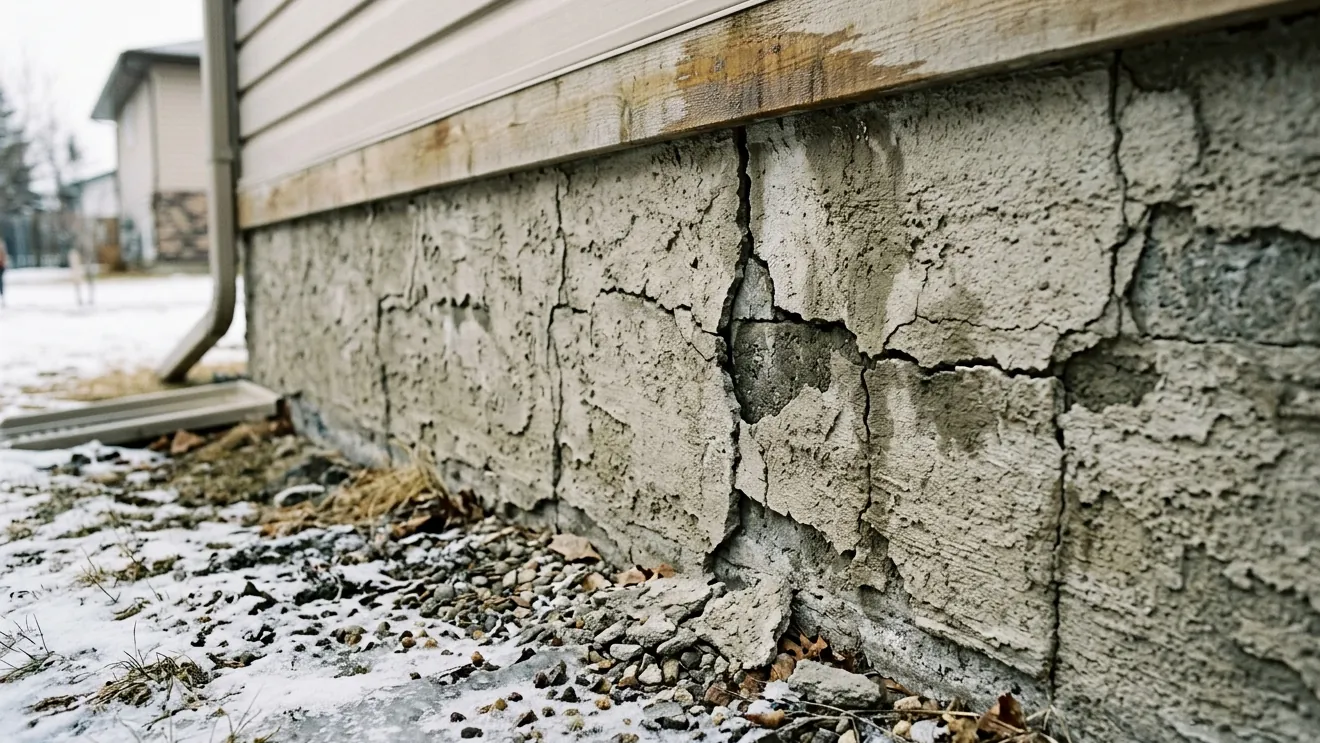
Why Parging Cracks Are So Common in Edmonton
Concrete and cementitious coatings like parging expand when warm and contract when cold. In most Canadian cities, this is a slow, manageable seasonal movement. In Edmonton, Environment and Climate Change Canada climate records show the city experiences more than 50 freeze-thaw transitions per year — rapid swings between below-zero and above-zero temperatures that subject parging to repeated expansion-contraction cycles in a single winter.
Each cycle is an opportunity for moisture to enter a surface gap, freeze, expand by approximately 9% inside the pore or crack, and force the opening slightly wider. A hairline crack in October becomes a visible crack by April. That same crack becomes a delaminated section by the following autumn if left unsealed. The Portland Cement Association's research on freeze-thaw resistance confirms this progressive failure mechanism in surface coatings — each cycle causes incremental damage that becomes exponential once moisture has access to the substrate beneath the coating.
Secondary causes of cracking include original application problems (parging applied without a bonding agent, or applied in cold or wet weather that prevented proper curing), UV degradation of older coating systems, and in some cases differential foundation settlement — which produces a distinctly different crack pattern than freeze-thaw damage.
Insert a credit card edge into the crack at its widest point. If it goes in more than 2–3 mm, the crack is wide enough to allow meaningful water penetration during rain and snowmelt events. At that width, moisture will enter freely during every wet period and freeze inside the wall each time temperatures drop — widening the crack further with every cycle. Seal before winter, not after.
The 4 Crack Types — and What Each One Means
Read your foundation before calling anyone. These four patterns cover the vast majority of what Edmonton homeowners see:
Type 1: Hairline Crazing — fine surface network
Monitor — seal before next winterMap cracking or crazing is caused by thermal contraction — the parging surface cooled and contracted faster than the layer beneath it, causing the surface to fracture in a distributed network. It is most visible in spring after a winter of repeated temperature swings. The parging is still attached and still providing some protection, but each crack is a moisture entry point that will widen with each freeze-thaw cycle.
Type 2: Thermal contraction cracks — single straight or slightly diagonal lines
Repair before next winterThese cracks form where thermal contraction stress concentrated — typically at weak points in the original application, areas of thinner coverage, or locations where the underlying concrete has a joint or discontinuity. They are parging-layer cracks, not structural cracks, but they provide a direct moisture pathway to the concrete beneath. Apply the 3mm test: wider cracks should be addressed before the next freeze season.
Type 3: Delamination cracks — outline of a hollow section
Address before next freezeThis is the crack type that warrants the most urgency. The parging has lost its bond to the concrete in that area — water is already pooling in the gap between the coating and the wall on every rain event, and freezing against both surfaces each winter. This is far more damaging to the underlying concrete than surface cracking because the concentrated ice pressure acts directly on the structural wall rather than the sacrificial coating.
If you find delamination cracks, tap the entire perimeter — not just the obvious section. Delamination rarely stays isolated. Use the 25% rule: if hollow sections cover more than a quarter of the wall area, full replacement is the more cost-effective path.
Type 4: Diagonal step or stair-pattern cracks — foundation corners and openings
Have assessed by a professionalDiagonal cracks originating from structural corners are a different category from the three types above — they may indicate differential foundation settlement rather than parging failure alone. The National Research Council Canada's Construction Research Centre identifies diagonal cracking from structural corners as a pattern requiring assessment for underlying movement before surface repair work is undertaken.
Three Tests You Can Do Yourself Before Calling Anyone
Width test: Insert a credit card edge into the widest point of the crack. Less than 2mm — monitor. More than 3mm — seal before next winter. Gaps wide enough to slide the card in freely indicate a crack that will allow significant water infiltration during heavy rain and snowmelt.
Tap test: Tap firmly with a hammer or coin every 20–30 cm around and on both sides of every crack. A solid sound means the parging is bonded. A dull hollow thud means the parging has delaminated from the concrete behind it. Mark every hollow section — the map of hollow areas tells you whether repair or full replacement is the right call.
Change test: If you have noticed a crack before, photograph it and put a date on it. Return in 4–6 weeks. If the crack has visibly widened or a new step has appeared, the underlying cause is active — either ongoing freeze-thaw cycling or foundation movement. A stable crack of the same width over multiple seasons is very different from one that is actively growing.
Why Cracked Parging Gets Worse Every Year Without Action
The mechanism is straightforward but the progression surprises most homeowners by how quickly it escalates. A 2mm crack in October allows a small amount of water in during autumn rains. That water freezes with the first hard frost and expands the crack to 3–4mm. More water enters during the next thaw and the next freeze widens it further. By spring the crack may be 6–8mm wide and the surrounding parging may have begun to delaminate from the added stress on the bond line.
This pattern is why a crack repair that costs $500–$800 in May becomes a sectional resurfacing job at $2,000–$3,500 by the following May, and potentially a full perimeter redo at $5,000–$8,000 by the year after that. The cost of parging repairs is almost always lower when the work is done at first observation rather than after one or two more winters of compounding damage.
When to call a structural engineer, not a parging contractor: Horizontal cracks running across the middle section of the foundation wall (which can indicate lateral soil pressure), diagonal cracks that are wider at the top than the bottom, or any crack that has measurably widened within weeks rather than seasons — these patterns should be assessed by a structural engineer before surface repair work is undertaken. Parging a wall with active structural movement does not fix the problem and may obscure cracks that need monitoring.
"I'd been watching two cracks on the west wall for a couple of years — figured I'd deal with them eventually. AxisLayer came out and showed me that one was a thermal crack I could seal, and the other had a hollow section behind it the size of a dinner plate that I'd never have found on my own. Fixed both properly that fall. The following winter was brutal and both repairs held without any movement."
— Homeowner in Edmonton (Terwillegar), 2024 projectWhat to Do Next
Once you have identified the crack type and done the three field tests above, the path forward is usually clear:
- Fine crazing with no hollow sections → seal this season, plan a full re-parging within 2–3 years
- Single cracks, 3mm or wider, tapping solid → targeted crack repair before next winter
- Cracks with hollow sections behind them → assess full perimeter, likely sectional or full replacement
- Diagonal cracks from corners → professional structural assessment before any surface work
If you are not sure where your foundation sits, our parging decision guide walks through the full assessment process, including the tap test and the 25% rule for repair vs. replacement.
Frequently Asked Questions
It depends on the crack type. Fine hairline crazing is low urgency. Cracks wider than 3mm, cracks with hollow sections behind them, or diagonal cracks from foundation corners require professional assessment — they indicate either active delamination or potential foundation movement.
Isolated cracks in otherwise sound, well-bonded parging can be repaired. If more than 25% of the surrounding parging is hollow on a tap test, full replacement is almost always more cost-effective over 10 years than repeated patching.
Edmonton's 50+ annual freeze-thaw cycles are the primary cause — moisture enters surface gaps, freezes, expands 9% inside the pores, and widens the crack incrementally each cycle. Secondary causes include original application without a bonding agent, application in cold or wet weather, and in some cases differential foundation settlement.
Three tests: (1) insert a credit card edge — if it goes in more than 3mm the crack needs sealing; (2) tap test around the crack — hollow thud means delamination; (3) check pattern — diagonal cracks wider at the top than bottom, or horizontal mid-wall cracks, can indicate foundation movement and should be assessed by a structural engineer.
Existing cracks allow moisture in during autumn. That moisture freezes each winter and expands, widening the crack slightly. Each spring reveals more damage than the previous fall. This cycle continues and accelerates until cracks are sealed before freeze season.
If you see horizontal cracks running across the middle of the wall, diagonal cracks wider at the top than bottom, or any crack that has measurably widened in weeks rather than seasons. These patterns can indicate foundation movement rather than parging failure and need structural assessment before surface repair work proceeds.
Last reviewed: April 2026 by the AxisLayer Exteriors team, Edmonton, Alberta.
Not Sure What Type of Crack You Have?
Send us a photo of the affected wall and we will identify the crack type, assess the urgency, and give you a straight answer on what it needs — no obligation.
Get a Free Assessment