The Alberta Winter vs. Your Foundation — and Why Edmonton Is Especially Harsh
Edmonton's "swing" weather — where temperatures can drop from +5°C to -20°C within 48 hours — isn't just uncomfortable for people. For unprotected concrete foundations, each temperature swing is a stress cycle that, repeated dozens of times per year, gradually destroys the surface from the inside out.
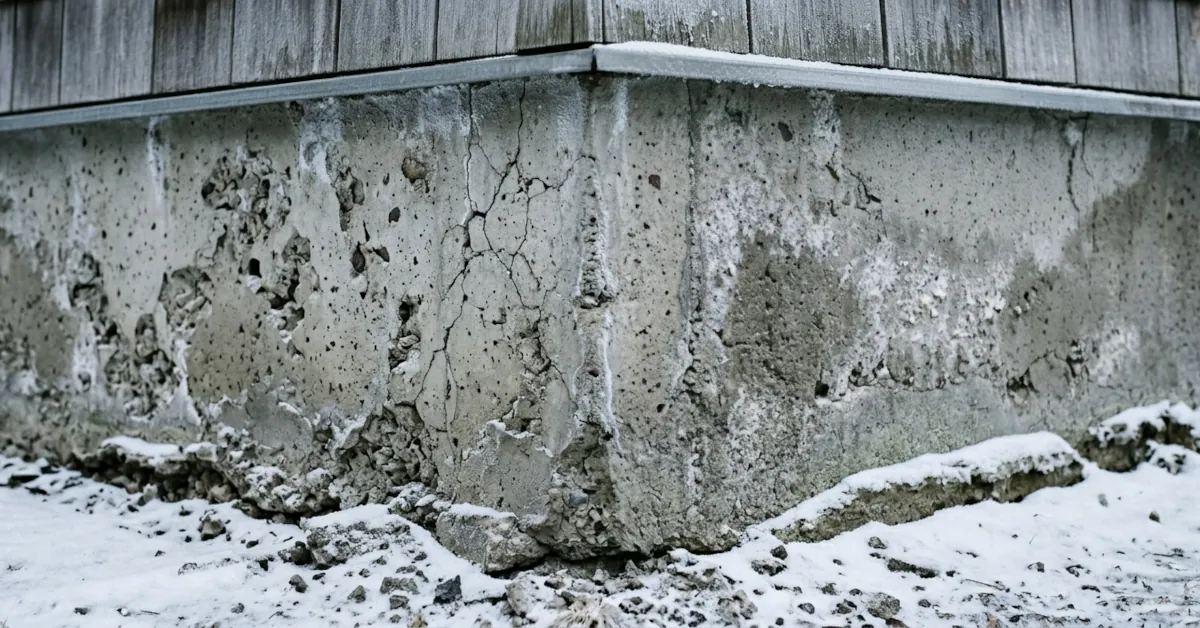
How the Freeze-Thaw Cycle Destroys Concrete
Concrete looks solid but is filled with microscopic pores — a network of tiny channels left behind as the cement cures. In Edmonton, moisture from rain, snowmelt, and ground saturation seeps into these pores during every above-zero period. When temperatures drop again, that absorbed moisture freezes.
Ice expands by approximately 9% as it forms. That expansion happens inside the concrete itself, generating internal pressure against the pore walls. A single freeze event creates thousands of micro-fractures throughout the surface layer. When the ice thaws, those fractures allow more water in during the next wet cycle — which then freezes again with even greater surface area to expand against.
Over 50+ cycles per year, this compounding process is what turns a foundation that looks fine in October into one with visible surface cracks and chipping by April. It is not a single dramatic event — it is slow, invisible, and cumulative.
Edmonton vs. other Canadian cities: Vancouver averages roughly 10–15 freeze-thaw cycles per year. Calgary gets around 70 but with less moisture during cold periods. Edmonton combines frequent transitions with significant snowmelt moisture, making it one of the most damaging environments for above-grade concrete in the country.
What Freeze-Thaw Damage Looks Like Year by Year
Homeowners are often caught off guard by how quickly a foundation deteriorates once the cycle takes hold. Here is a realistic progression on an unprotected Edmonton foundation:
The 4 Signs Your Foundation Is Suffering Freeze-Thaw Damage Right Now
Spalling — concrete flakes or coins falling off the wall
Address before next winterSpalling is the most recognisable sign of advanced freeze-thaw damage. You will see it as thin, roughly circular or irregular pieces of concrete detaching from the surface — sometimes in chips, sometimes in larger slabs. The exposed material underneath looks dark, rough, and raw. This is active structural concrete being removed by ice expansion.
Pitted surface — pot-hole texture across the wall face
Repair this seasonA foundation with a rough, cratered texture — like sandpaper scaled up — is showing the cumulative result of many freeze-thaw cycles removing small amounts of surface material each winter. The pits are former pores and micro-fractures that have been enlarged by repeated ice expansion. Each pit now holds more water than the original surface did, accelerating the next round of damage.
Crumbling edges — corners and base of wall breaking away
Address promptlyThe lower corners of the foundation and the base of the wall near grade level are the most moisture-concentrated zones — water pools here from rain, snowmelt, and lawn irrigation. Crumbling at these points is a sign that freeze-thaw damage has progressed deeper than the surface layer. These areas often delaminate in larger sections rather than small chips.
Hairline spiderweb cracks — fine network of surface fractures
Monitor and act this seasonA fine network of interconnecting cracks across the parging or concrete surface — often called "map cracking" or "crazing" — is an early warning sign that freeze-thaw stress is building. These cracks are small now, but each one is a pathway for moisture to penetrate deeper into the wall for the next freeze cycle. Left alone, they widen steadily each spring.
How Parging Stops the Freeze-Thaw Cycle
We cannot change Edmonton's weather. What we can change is how your foundation responds to it. Professional foundation parging works as a sacrificial exterior layer — denser than raw concrete, with fewer and smaller pores for moisture to enter. Instead of your structural foundation wall absorbing and freezing water with each cycle, the parging coating does.
When acrylic-modified parging systems are used — which we recommend for Edmonton's temperature range — the coating also has a degree of flexibility that allows it to absorb freeze-thaw movement without fracturing. A traditional sand-cement parging is more rigid; it will protect the concrete beneath it, but it is more likely to develop surface cracks over many seasons. The right system depends on your foundation's age, existing condition, and budget.
Why Hardware Store Patches Fail After One Edmonton Winter
The failure rate of DIY parging patches in Edmonton's climate is high, and the reasons are consistent across almost every case:
- Wrong mix design. Generic bag cement is not formulated for the -40°C to +30°C range Edmonton foundations experience. The cement matrix contracts and expands differently than professional mixes designed for Prairie conditions, causing the patch to crack from thermal stress alone.
- No bonding agent. Without a professional-grade bonding agent applied and allowed to reach the correct tack before the new material goes on, there is no lasting chemical key between the patch and the existing concrete. The freeze-thaw cycle attacks that unbonded interface and pops the patch off — typically within one winter.
- Inadequate surface preparation. Applying new material over loose, dirty, or still-spalling concrete guarantees early failure. The new material bonds to the weak layer, and the weak layer separates from the wall. The only correct approach is to grind back to clean, sound concrete first.
"We patched the same north-facing section three times with stuff from Home Depot. Every spring it was back on the ground. AxisLayer came out, ground the whole area back, used their bonding system, and applied a proper coat. That was two winters ago — not a single chip. I wish someone had told us earlier that the prep work is everything."
— Homeowner in Spruce Grove, 2023 projectWhat Does Fixing Freeze-Thaw Damage Cost in Edmonton?
Cost scales directly with how far the damage has progressed — which is why the most common advice we give is to act at the first signs rather than waiting for a winter or two to confirm the problem.
- Early stage — hairline cracks, minor pitting: $500–$2,500 for targeted sectional repair
- Mid stage — active spalling across sections: $3,000–$7,000 for remediation and full-perimeter parging
- Advanced stage — deep spalling, crumbling edges: $8,000–$15,000+ depending on depth of damage and wall area
Our full 2026 Edmonton parging cost guide covers pricing by project type and finish, and our repair vs. replacement guide helps you decide whether a targeted patch or a full redo makes more sense for your specific situation.
Frequently Asked Questions
It occurs when water soaks into porous concrete and freezes. Ice expands by approximately 9%, generating internal pressure that fractures the concrete surface from within — a process called spalling. Each cycle widens existing cracks, allowing more water in for the next freeze.
More than 50 — significantly more than milder Canadian cities. Edmonton's rapid swing weather, where temperatures can move from -20°C to +5°C within a couple of days, is particularly destructive because it allows moisture to absorb, freeze, and thaw in rapid succession throughout winter.
Parging acts as a sacrificial exterior layer. It is denser than raw concrete with fewer pores for moisture to enter, and acrylic-modified systems add flexibility to absorb thermal movement. Instead of structural concrete spalling away, the parging weathers in its place.
In most cases, no. Surface spalling and pitting can be ground back to clean concrete and resurfaced with a bonded parging system. The exception is when damage has reached reinforcing steel inside the wall — at that point a structural assessment is needed before cosmetic repair can proceed.
Three consistent reasons: generic bag mixes are not formulated for Alberta's temperature extremes, bonding agents are usually skipped, and surface preparation is insufficient. Without proper prep and bonding, freeze-thaw expansion attacks the interface between patch and concrete and pops the new material off within one to two winters.
Early-stage targeted repairs run $500–$2,500. Mid-stage spalling with full-perimeter parging runs $3,000–$7,000. Advanced damage can reach $15,000 or more. Acting at first signs is consistently the most cost-effective path — see our detailed cost guide for a full breakdown.
Last reviewed: April 2026 by the AxisLayer Exteriors team, Edmonton, Alberta.
Protect Your Foundation From the Elements
We specialise in Edmonton-tough parging built for the -40°C to +30°C range your foundation endures every year. Send us a photo of the damage and get a straight answer on what it needs.
Get a Free Quote